Surfers Still Show up here, but Tamarindo now Hosts Many More Upscale Tourists Today
Every year, I have to take a cross-border run and return to extend my time in Colombia another 90 days. This year (2026), I took it in Tamarindo, Costa Rica. It’s not a place I had been hungering to visit. In fact, I didn’t know anything about the place except that it was a small village on the Pacific Ocean near the Nicaraguan border. I chose this location only because a cab driver in San Jose once told me that it was his family’s favorite vacation spot in Costa Rica. After I got there, I soon realized that I was one of the few people who had never heard of the place. That was surprise number one.
Before I left on his trip, I became a little depressed when I imagined my time in Tamarindo would be spent merely sitting on some beach instead of challenging my mind and body with new experiences or generating new thoughts and insights about life in general. I thought I had reached the final stage of my life because my body acted as if it had thrown in the towel. I was suffering from a sprained wrist that stubbornly refused to heal and lower back pain that would mysteriously appear and disappear. I was ready to give up jogging. Worst of all, life no longer seemed to offer any surprises. Clearly, I had grown old and mortal.
Despite having devoted my life to healthy living, I saw myself marinating my insides with alcohol and microwaving my outsides under the broiling sun as the only likely outcome of this little excursion. My only act of courage would be daring the health gods to cast skin cancer and cirrhosis of the liver down upon me. To make matters worse, one friend, only about 10 years younger than me, would be climbing Mount Kilimanjaro at the same time I was rotting away on a beach. Another friend, a couple of years younger still, would be preparing for her 285th marathon, and a childhood friend would probably be skiing in the Adirondacks or Vermont. Instead, I would be wasting my life on this border run while they were living theirs.
I was wrong. Tamarindo turned out to be a rather healthy place. I didn’t spend my time lying in the sun and was constantly moving around, swimming, and exploring the village.No, I Didn’t Ride the Horses, but I Could HaveI also found myself in situations that made me think about life in general (not just my own), and I even found some excitement on my way to and from Tamarindo. Well, the excitement was very small and consisted mainly of the difficulties I experienced flying to Tamarindo and getting home again. South American countries are responding to Trump’s anti-immigrant policies by tightening up their own immigration regulations. They are particularly cracking down on U.S. citizens overstaying their tourist visas. They now require that American tourists have a return ticket back to the US before entering. This is not a new policy, but they are now actively checking this, and, more importantly, they want to see the ticket, not just an email confirming that you originally bought one. After all, what would prevent you from cancelling your ticket, pocketing a credit on your card and remaining forever more in their country? The government leaves enforcement of this policy to the airlines. If you buy a round-trip ticket with the same airline, they will usually let you board the flight to the new destination, but if your return ticket is with a different airline, nope, no go. You’d better have an actual ticket with you. Up until this trip, I had always been able to use an email confirmation to prove a return ticket; I was unaware of the new way this requirement was being enforced. To complicate matters further, I used Kiwi to purchase the tickets for all six flights my trip would require. This was a big mistake (in other ways, too). My first problem occurred at the very beginning of my trip at the Medellin airport. I was travelling on Avianca airline from Medellin to San Jose, but I wasn’t allowed a boarding pass because I didn’t have in my hand a ticket from Wingo airlines that would return me to Medellin 3 days later. Costa Rica would not let me in without this, and Avianca was enforcing the rule. Lucky for me, Wingo had a counter at the Medellin airport, and there were actually people there. Could they print out my return ticket? Their printer was broken. They gave me a handwritten ticket without a QR code, but after lengthy discussions with Avianca, they issued me a boarding pass, and I passed through immigration and onto the plane. I put the handwritten ticket in my wallet, imagining it would come in handy later for my return flight. (It didn’t).
When I arrived in San Jose, my next task was to find the domestic terminal from which Sansa Airlines would fly me to Tamarindo. To do this, you had to leave the main terminal and walk a block or so down the street. The domestic terminal is small and houses the ticket counters for Sansa and another domestic airline. Neither airline flew large planes.Sansa’s Largest Plane at Tamarindo’s AirportWhen you check in, they weigh both you and your luggage because too much weight can make take-off and landing difficult. I always pack light, and I had no problem exceeding the weight limit, but I had other problems. My Avianca flight had been delayed, and I missed my connection to Tamarindo. I had plenty of warning of this delay at the Medellin airport and contacted Kiwi to see if I could transfer my ticket to a later flight. Kiwi said I would have to contact Sansa for that. Thank you for your service, Kiwi! I emailed Sansa, and there was no response. I called them on my phone. Nobody picked up. When I got to San Jose, I asked if I could get credit for taking a later flight. The answer? “Nope”. Luckily, there was an empty seat on a flight that afternoon. I bought a second ticket to Tamarindo, which increased my total airfare by 30%. Kiwi had cost me money rather than saved it. The domestic airport has no electronic board indicating when flights are leaving. Instead, the staff call out your name when your plane arrives. The names were called out in Spanish, and I recognized none of them. After several false starts, a nice Spanish-speaking person sitting next to me said, this is the flight to Tamarillo.
My plane was alarmingly small. There was only a single engine sitting in front of the pilot and co-pilot, and it seated only 12 passengers. I was surprised when a huge guy got on the plane and sat in the single seat ahead of me. How the hell did he make it through the weigh-in? I then understood the pilot’s logic when he sat two solidly built women in the double seat across from him. They would balance him out so the plane could fly level. Once we were airborne, some unsettling events began to occur. A lady had brought a cat in a cat carrier, which was stored in the back of the plane behind the seats. I don’t think the cat relished the flight much. Every time we hit turbulence, it would scream. What was worse was that even when the plane flew smoothly through the air, it would still trill out a constant high-pitched growl. The other issue that caught my attention was a crack in the upper left-hand corner of the copilot’s window, steadily weeping moisture. The co-pilot had to grab a rag to wipe the window clear every couple of minutes.
Actually, other than that damned cat, the flight was interesting and fun. The plane flew low enough so I could trace the streambeds and dirt roads below. The streambeds ran through the valleys, and the roads often, though not always, followed the hilltops. There were many hills for the roads to travel over. The landscape was clearly volcanic in origin, with many lumps of eroded volcanic cones popping up here and there.
When we arrived over Tamarindo, I was surprised how small the village appeared. I wondered if my hotel would simply be an adobe building with a few fans slowly circling in the ceiling. I soon replaced that worry with one about the airport. I didn’t see one. As we turned in the air, we dropped closer and closer to the ground. Finally, I saw the roofs of some farm buildings next to what looked like a two-lane highway. That turned out to be the landing strip. As we neared the ground, I could see that we were really going to attempt to land on that two-lane strip. The plane squawked down on the asphalt, the cat went insane, and barbed wire fences rushed past the windows on each side of the plane. I had arrived at Tamarindo.
It turned out that the airport was owned by the hotel where I was staying, the Hotel Diria. It was one of the first hotels to make a major investment in Tamarindo and even blasted through a hill at the edge of the village to build the road between the hotel and its airport. The road out of the airport was a rough dirt track that dipped down into a dry streambed and up and back out the other side. It passed a dried-out golf course before reaching a paved road that led into the village. Here, traffic backed up as it chugged between ranks of bars, restaurants, souvenir shops and other tourist flotsam and jetsam. My cab then pulled into the courtyard of a large, surprisingly modern hotel, the Diria.The Beach in Front of the DiriaLooking Out at the Pacific from the DiriaWhile at the reception desk, I turned to look past the open area of the swimming pools, through the bar and restaurant, to the bright sandy beach and the dark blue Pacific beyond. The ocean was not very pacific, though, since some of those waves were two stories high!Looking Out From the Beach
I received a plastic wristband that contained a small transmitter that would open my room door (if I rubbed it the right way against a metal plate hidden on the door) and would inform staff that I was a paying guest for breakfast and dinner. My room was nice enough. The air conditioner functioned as it should, but the TV volume was permanently set so low that it exhaled only whispers. Maybe this was fortunate since the video version of the news was troubling enough.
Dozens of tourists were constantly coming and going through the Diria’s lobby. Out on the street, hundreds more were visiting the shops, buying ice cream, or circulating in and out of the many other hotels and restaurants that make up most of the village today. I wondered, “Where the hell did all these people come from? Surely they didn’t all fly in on little 12-seater planes”. My answer arrived immediately in the form of a tour bus, which disgorged its contents onto the sidewalk in front of me. A bus trip from San Jose to this remote spot must take half a day. I was glad to have taken the plane despite the cost and the cat.
Although my watch, which had magically changed time zones, told me it was only three o’clock in the afternoon, I was hungry and found a wine bar/restaurant a few hundred feet down the sidewalk from the Diria. It was one of those places where the tables spilled out from the inside of the restaurant and onto the beach.The Wine Bar (Click to enlarge)I ordered grilled octopus and marveled at how easy it was for me to order and pay for meals. The restaurant took US dollars, the menu was in English, and the waiters all spoke excellent English. Actually, you were more likely to receive the food you ordered if you ordered in English rather than attempt Spanish, since the waiters at this restaurant all grew up in the US and seemed to struggle with my version of Spanish. The restaurant had a DJ who was playing disco music, and as one song melted into a more jiggy one, he called out, “Everyone get up and dance!” At the table next to mine, 7 or 8 college-age girls looked at each other, laughed, and rose to start dancing. Some were pretty adept at it, really throwing themselves into the music, while others were more awkwardly trying to follow along. I sat there thinking to myself, “Even at their age, I would never have agreed to follow the group to do something that would make me feel foolish.” Copying the group is no camouflage at all if it makes you look awkward. I’d rather refuse to hide behind group conformity than do stuff that made me feel uncomfortable. Instead, I’d prefer to seek out that other type of anonymity where I try to withdraw from the group and disappear into the background. I’d rather become Emerson’s “invisible eyeball” observing everything without being part of it. Observing without being observed, or at least without being completely noticed.
While sitting there, rolling this idea around my mind, it occurred to me that the group’s prettiest girl was one of the most awkward dancers. It struck me that she was passing through that wavering grey realm that lies between uncertainty and self-confidence. Not all women are lucky enough to experience this transition, and when it does occur, it lasts no longer than the brief fluttered life of a mayfly. Women either quickly accept they are beautiful and wear this garment comfortably or retreat back into eternal uncertainty. (or even darker, more uncomfortable places). She already seemed to vaguely understand that she was pretty. Her clothes were less revealing and possessed more muted colors than the rest of the girls in the group (one of whom wore a string bikini – a disastrous mistake), but the prettiest girl had clearly selected her outfit to quietly support what she knew were her best features. As the other girls bounced down to the beach in their extroverted swimwear, she followed along behind, probably not realizing that she would someday cease wading in the shallows with these friends and dive into an ocean of potential.
Well, it feels like it’s time to address the broader issue of why Tamarindo became such a popular vacation spot. I had to ask around to learn about the village’s history because, apparently, I have been living under a rock, unaware of its very existence. As late as the early 1960’s, Tamarindo was simply an isolated fishing village that possessed no electricity or running water. Sometime during the 60’s, a surfer pulled through and noticed that a broad flat shelf in the ocean outside the village produced large waves and long rides.Tamarindo’s WavesToday’s SurfersThe word got out to other surfers, and a small colony of them hung on here into the 1970’s while Tamarindo remained unknown to the rest of the world. There was still no electricity or running water, and the surfers lived in huts and survived on fish and produce bought from the local villagers. Most of those surfers who lived here more or less permanently wouldn’t have been able to afford a hotel even if one existed. At some point in the 1970’s, the surfing movie “The Endless Summer” used Tamarindo as one of its locations, and the village became famous overnight. Many surfing wannabees started showing up after that, and the investors behind the Diria built a hotel to cater to these tourists. They also invested in the village’s infrastructure to include water, electricity, and sewage disposal. Once this occurred, tourism exploded, with many new hotels and restaurants constructed, and the Diria itself experiencing several expansions and upgrades. People also started building second homes outside the city, and prices for everything skyrocketed. There are still a few surfers sliding down the waves beyond Tamarindo’s beach, and a few surf shops continue to cater to their needs, but most of the original surfing community has surrendered the village to wealthy tourists.Surf Shop on the Beach
The village’s economy is now almost entirely focused on this short-term tourism. Do you fancy a brew pub? It has one.
One of the Many Souvenir Shops
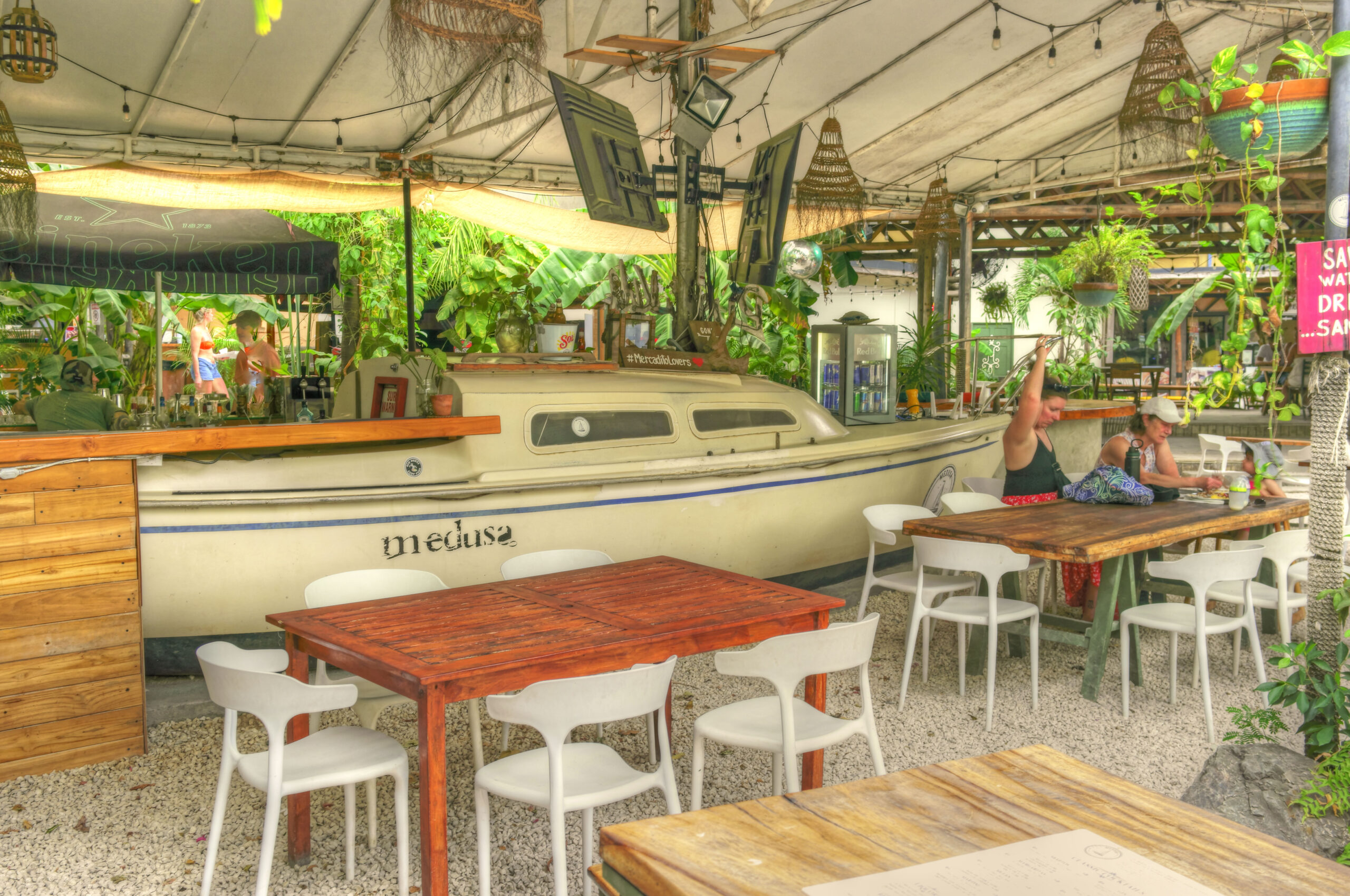
Boat Themed BarBeach Refreshment Stand
Need an ATM? They are here too, though you probably won’t need one. Do you miss your morning Starbucks coffee? Tamarindo harbors one of the largest, most modern Starbucks I’ve ever visited, plus it might operate the most powerful air conditioner in the village. Raw beef could be hung inside for weeks without going bad. Discos? There are several, though Tamarindo becomes very quiet after 10 pm. In fact, it pretty much shuts down. I suspect that the village has become too expensive for most young people who would rather party into the night elsewhere than travel here. The empty streets, closed shops, and restaurants brought home a feeling of unreality that had been flitting through the back of my mind all day. Nearly everyone on the street was a transient like me, and only a skeleton crew of local workers maintained the thin coating of necessary activity that defined visible life in the village. When I asked a couple of these workers where they lived, none lived in Tamarindo, and all commuted in from neighboring towns, some as far as 30 miles away. Of course, no one would want to live here full-time since Tamarindo has become an escapist’s mirage that can’t satisfy our human thirst for a normal day-to-day existence, or where working people can comfortably live and thrive.
The one counterargument to this insight was the farmer’s market held in Tamarindo’s central park on Saturday mornings. Farmers from the countryside brought in fresh produce and juices, and some people did their everyday shopping there. However, this market also sought to satisfy tourists’ escapist dreams by selling handmade furniture, jewelry, tropical oils, and potions.
On the first full day I spent in Tamarindo, I got up early to walk from the Diria to the south end of the beach and then reversed course and walked past the hotel to the north end.
The Morning Beach at Tamarindo
The beach itself is about 1.5 miles long. I took most of my pictures of the beach and the ocean on this first day. At the south end were a couple of acres of low rocks where you could seek out wildlife caught in the tidal pools. Surfing still occurs at the north end, where a freshwater river empties into the ocean.
The Fresh Water River
There is a sign here that warns you to watch out for crocodiles. This danger is minimal because these crocs live only in fresh water, and the tides that push saltwater upriver usually keeps them farther inland. Heavy rains, however, can wash this saltwater out of the river, and then they can travel to the ocean in search of food. The rains also turn the river muddy, so you might step on one if you were unwise to enter the river then. The river was clear and salty the day I waded across it. That day, I also photographed the many boats anchored about a quarter of a mile off the shore.
Boats Beyond the Surf
My happiest
Nice Live Aboard Catamaran
moments in Tamarindo occurred at night while sitting on the beach looking out at the dim lights that peeked out from some of the boats’ cabins and listening to the waves softly rubbing up and down the sandy shingles of the beach. The whole experience was very soothing. I was at least momentarily at peace with the world. I acknowledge that not everyone will experience nighttime on the beach the same way I did. The writer Mathew Arnold characterized the same situation as “the confused alarms of struggle and flight, where ignorant armies clash by night”. Although this line is from a fine poem, Arnold was well-known for his pessimism, so much so, that at his funeral one friend turned to another and said, “Matt has gone on to a better place.” The friend replied, “Yes, but he probably won’t like it much”. 🙂 I decided I would support Arnold’s fine musings some other night when I was less content
The following day I jogged the same distance to work off the excess fish and ice cream I had been consuming. I took no pictures that day of the beach. Instead, I showered and took my camera to explore the rest of the village. The main road along the beach has been paved, as have two other roads at the ends of town. The rest of the village’s streets are dirt roads that I wandered around most of the afternoon. I’m not sure I had received the full story about Tamarindo’s past and later development, because I kept stumbling across gated mansions that looked like they had been here for generations.
Who Lives in These places?
I doubted that any old surfers lived in them and wondered who else (with the kind of money needed to build them) was around when they were put up. Anyone with enough money to build one of these piles would find little of interest to do here. Tamarindo has no symphony orchestra, and no museums. I didn’t even see a library in the village. How do you spend your time here after having eaten in all the restaurants and eaten dozens of cups of ice cream? I suppose you could sit in your mansion and read or watch TV, but you don’t need a mansion for that. Possibly you could invite friends to visit you and entertain them there, but you would have to have hundreds of friends to fill up the weeks or months you’d have to live there in order to justify its cost. That’s probably the explanation. To own this place, you must have so much money that you don’t have to justify the cost for living there only a few weeks out of the year.
If you imagine Tamarindo is paradise and that you could escape the depressing politics of the outside world by living here full time, think again. It’s impossible.
My problems with Kiwi rose their ugly heads again that second day. Kiwi sent me emails that said my return flight with Sansa would be delayed and that I should contact the airline immediately to find out the new schedule. As I had done previously, I emailed and called Sansa but got no response. Since the Diria owned the little airport, I felt I had a surefire solution to this problem. I located the hotel’s concierge and had her call the airport. There was no answer. She said, “That’s strange. I was just talking to them yesterday”. Off and on over the next two days, we tried to contact the airport, but there was no answer. Finally, on the last day, I asked the concierge if I should go to the airport anyway. She said go, and if the flight was cancelled, we’ll get you a room for another night, and you can try again tomorrow. I arrived at the airport. Kiwi was wrong. The flight wasn’t cancelled or delayed. The ticket agent gave me a plastic card that served as a boarding pass (Sansa does not print boarding passes; you give the card to the pilot when you enter the plane). Another man was sitting at a desk next to the ticket agent, working on some paperwork. As the ticket agent weighed me and my bag, the other man’s phone rang. He kept working. After a while, the phone stopped ringing. The Kiwi/Sansa incident was only a minor inconvenience to what came next. When I reached San Jose, I took out the handwritten ticket I had received from Wingo Airlines in Medellin and went to the Wingo counter to pick up a printed boarding pass. Unfortunately, the Wingo computer wasn’t working any better here than its printer was working in Medellin. The ticket agent had to write out the boarding pass. Even more unfortunately, the original handwritten ticket did not contain a QR#, whatever that is. When I got to the Costa Rican immigration counter, the agent told me that I could not pass through without the QR#. I went back to Wingo, the ticket agent there grabbed a Wingo employee who spoke excellent English, and we travelled together back to immigration. He explained the computer problem. The agent’s response? “Sorry, you shall not pass”. We called in the immigration agent’s supervisor. “No way. Only the police can authorize this person to leave Costa Rica”. I started to speculate about how much it would cost to rent an apartment in Costa Rica and live here permanently if I couldn’t return to Colombia. 🙂 Of course, that’s not going to happen. They would send me back to the frigid US instead. We visited the airport police. They listened to the Wingo employee. They looked at my passport. They played with their computer for a few minutes. They looked at me, and then each other. My flight to Medellin was due to leave in 10 minutes. The police chief looked at me again, shrugged, and wrote something on my ticket. I was free to go. I expected further trouble getting through Colombian immigration when I arrived in Medellin, but I breezed right through. Maybe all my in-and-out entries to Colombia on my passport convinced the agent that I had been fully vetted many times over. Whatever the case, I sighed in relief as I got into a cab back to my apartment. What have I learned from this? First of all, never buy airline tickets through ticket consolidators. Always buy from the airlines directly. Secondly, always buy round-trip tickets through the same airline. You’ll have better evidence that you have a return ticket that satisfies government immigration requirements. Oh, and I liked Tamarindo, but I wouldn’t want to live there. 🙂 T
A graduate of Hamilton College, SUNY Binghamton, and the American College, I've continued my education as an autodidact and world traveler. I tour the world seeking to understand what I see.